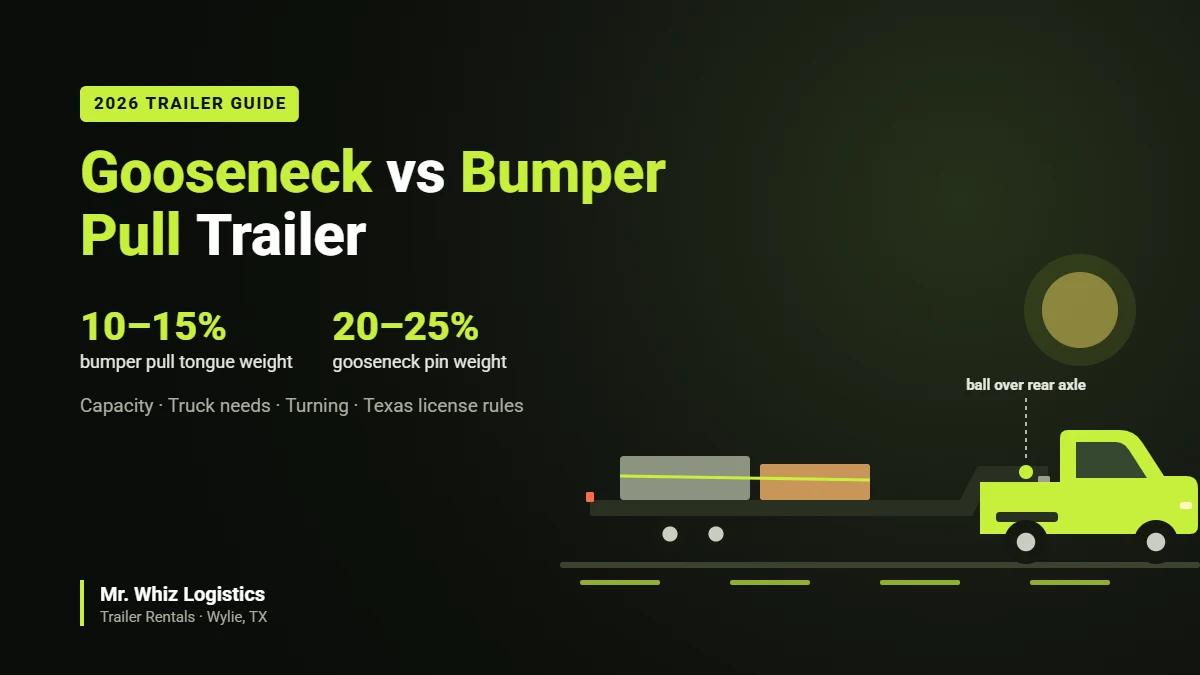
Gooseneck or bumper pull? It's the first question when you rent or buy a flatbed, dump or equipment trailer. The short answer: a bumper pull hooks to a receiver hitch at the back of your truck and handles most loads up to about 14,000 lbs. A gooseneck hooks to a ball in the truck bed, carries 20,000 lbs or more, and tows more steadily, but it needs a heavy-duty pickup with a bed-mounted hitch.
This guide compares the two hitches side by side: capacity, tongue weight, truck needs, turning, cost, and which works best for dump trailers, equipment and skid steers. It also covers the Texas license and brake rules that apply to each. For the full legal picture, see our Texas trailer laws guide.
Gooseneck vs. Bumper Pull at a Glance
Bumper pull | Gooseneck | |
|---|---|---|
Where it hooks up | Ball on a receiver hitch at the rear of the truck | 2-5/16" ball in the truck bed, over or just ahead of the rear axle |
Typical trailer ratings | About 3,000 to 14,000 lbs | About 15,000 to 30,000 lbs |
Weight on the hitch | 10–15% of the loaded trailer | Often 20–25% of the loaded trailer |
Tow vehicle | Pickups and many SUVs, matched to the trailer | 3/4-ton or 1-ton pickup with a bed hitch |
Stability | Good when loaded right; more prone to sway | Very stable; little sway |
Turning | Wider turns | Tighter turns, but the trailer cuts further inside |
Truck bed | Stays free for cargo | Hitch sits in the bed |
Cost | Lower: smaller trailers, standard hitch | Higher: bigger trailers, plus a bed hitch |
Hitch type doesn't create capacity on its own. The lowest rating in the setup decides what you can tow. That includes the trailer's GVWR, the hitch rating, and the truck's towing capacity, payload and axle ratings.
How a Bumper Pull Hitch Works
A bumper pull trailer's tongue drops onto a ball mounted on a receiver hitch under the rear bumper. Receivers come in classes, and each has a maximum rating, according to TowingSpecs:
Hitch class | Receiver | Max trailer weight | Max tongue weight |
|---|---|---|---|
Class III | 2" | 8,000 lbs | 800 lbs |
Class IV | 2" | 12,000 lbs | 1,200 lbs |
Class V | 2.5" | 20,000 lbs | 2,700 lbs |
Your truck's own rating can be lower than the hitch's, so check the owner's manual. Most utility trailers use a 2" ball. Heavier bumper pulls, like car haulers, dump trailers and larger enclosed trailers, usually take a 2-5/16" ball.
How a Gooseneck Hitch Works
A gooseneck trailer has a long neck that reaches over the tailgate and couples to a 2-5/16" ball mounted through the truck bed into the frame. Because the weight sits over the truck's rear axle instead of behind it, the truck carries the load more evenly and handles more weight. A common aftermarket gooseneck hitch, the Husky 35202, is rated for 35,000 lbs of trailer and 8,750 lbs on the ball.
Many 3/4-ton and 1-ton pickups can be ordered with a factory gooseneck prep package. Otherwise, the hitch has to be installed under the bed. When you're not towing, most bed hitches let you flip or remove the ball, so the bed is flat again.
Bumper Pull Pros and Cons
Pro: works with more vehicles. Half-ton pickups and many SUVs can pull smaller bumper pulls, and nearly any pickup can tow a light utility trailer.
Pro: lower cost. The trailers are smaller and cheaper, and many trucks already have a receiver.
Pro: bed stays free for tools, coolers or extra cargo.
Pro: easy to hook up. You can see the ball from the driver's seat with a backup camera.
Con: more sway, especially in crosswinds or with too little tongue weight.
Con: lower capacity. Most top out around 14,000 lbs, and the rear-mounted weight levers up the truck's front end.
Gooseneck Pros and Cons
Pro: carries more. Goosenecks are built for 15,000 to 30,000 lb loads. Our 40 ft gooseneck flatbed, for example, is rated at 20,000 lbs.
Pro: tows steadier. With the weight over the rear axle, goosenecks sway much less, which you'll notice on I-20 or I-35 in a North Texas crosswind.
Pro: tighter turns. The pivot point sits inside the truck's wheelbase, so a gooseneck can make sharper turns into job sites and tight lots.
Con: needs a heavy-duty pickup with a bed hitch and enough payload. SUVs and vans can't tow one.
Con: costs more, both the trailer and the hitch.
Con: the hitch takes up bed space, and in a very sharp turn the trailer's front corners can come close to the cab or bed rails.
Tongue Weight and Payload: The Math That Decides
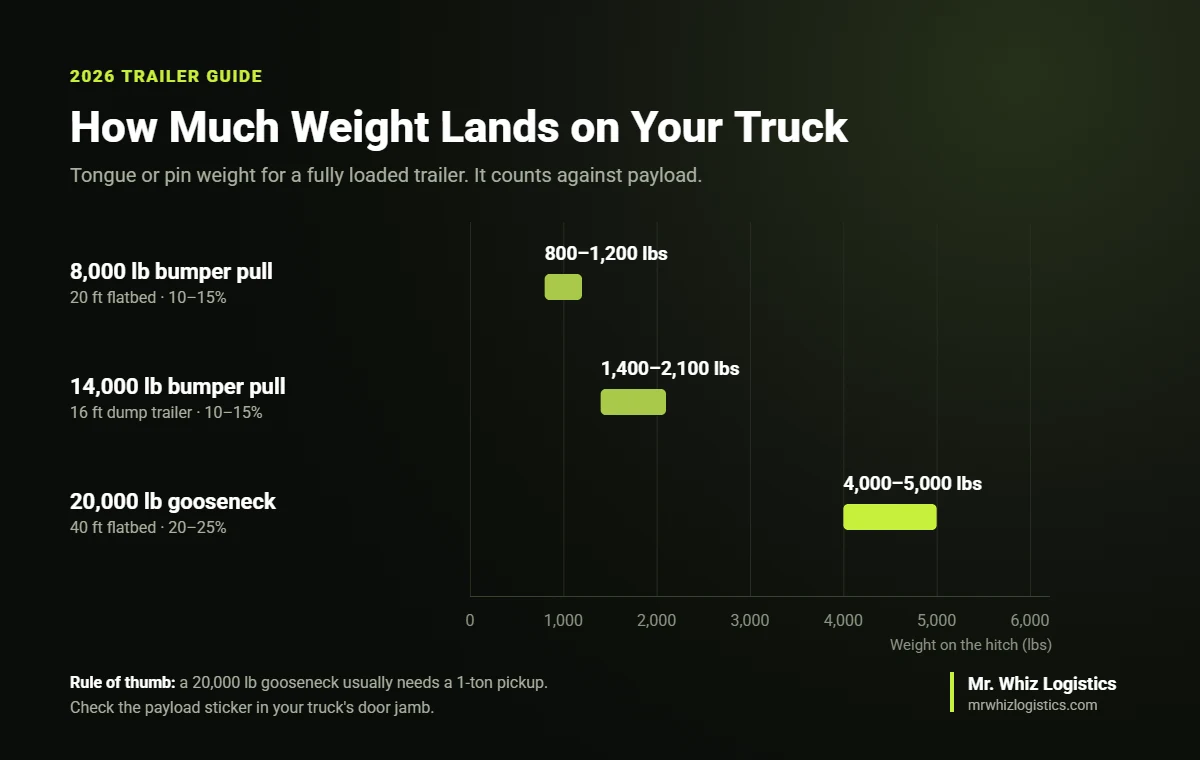
Tongue weight (on a gooseneck, it's called pin weight) is the share of the loaded trailer that presses down on your truck. It counts against your truck's payload, the number on the yellow tire and loading sticker in the driver's door jamb. TowingSpecs recommends 10–15% for bumper pulls and notes that goosenecks routinely run 20–25%.
Loaded trailer | Hitch | Weight on the truck |
|---|---|---|
8,000 lbs (20 ft flatbed) | Bumper pull, 10–15% | 800–1,200 lbs |
14,000 lbs (16 ft dump trailer) | Bumper pull, 10–15% | 1,400–2,100 lbs |
20,000 lbs (40 ft gooseneck flatbed) | Gooseneck, 20–25% | 4,000–5,000 lbs |
That last row is why goosenecks need a 3/4-ton or, more often, a 1-ton truck. Remember that passengers, fuel, toolboxes and the hitch itself count against payload too. If you're over, the truck can feel light in the steering and take longer to stop.
Turning Radius and Handling
A gooseneck pivots over the truck's rear axle, so it can turn more sharply than a bumper pull of the same length. That helps when you back into a job site or swing through a tight gas station. The tradeoff is that the trailer's wheels track further inside the truck's path. Take turns wider than feels natural, and watch the inside curb and posts.
A bumper pull pivots behind the bumper, so it needs more room to turn, and it can jackknife into the truck if you back up too sharply. With either hitch, slow down before curves, keep about 60% of the cargo weight ahead of the trailer axles, and leave extra room to stop.
Which Is Better for Dump Trailers, Equipment and Skid Steers?
Dump trailers: A 14–16 ft bumper pull dump rated around 14,000 lbs covers most home and landscaping jobs. Contractors hauling full loads of gravel or demolition debris every day often go gooseneck for the extra capacity and stability. See our guide to dump trailer rental costs.
Small skid steers: A Bobcat S70 weighs 2,892 lbs and is 35.5 inches wide, so it fits easily on a bumper pull flatbed or utility trailer.
Compact track loaders: A Bobcat T770 weighs 10,515 lbs before attachments. That's beyond an 8,000 lb trailer and close to the limit of a 14,000 lb bumper pull once you add the trailer's own weight. A gooseneck is the safer choice.
Cars and trucks: A bumper pull car hauler handles most single vehicles. Two cars, or a heavy pickup, call for a gooseneck. Our flatbed trailer rental guide breaks down sizes.
Hot shot freight: Many hot shot carriers run 30–40 ft goosenecks behind 1-ton trucks, because they carry more per trip. See our 40 ft flatbed hot shot service.
Texas License and Towing Rules for Each
Texas doesn't care which hitch you use. It cares about weight ratings. Here's how the main rules apply:
License: You need a Class A license when the trailer is rated over 10,000 lbs and the truck and trailer together are rated at 26,001 lbs or more (Texas DPS). A 20,000 lb gooseneck behind almost any pickup crosses that line. A 14,000 lb bumper pull dump crosses it too when the truck is rated at 12,001 lbs or more. An 8,000 lb trailer never does, so a regular Class C license works.
CDL: If you tow that Class A combination for business, you usually need a Class A CDL. Our hot shot requirements guide explains the federal rules.
Brakes: Trailers with a gross weight over 4,500 lbs need working brakes when towed faster than 30 mph, plus a breakaway system (Transp. Code §547.401). That covers nearly every gooseneck and most loaded bumper pulls over 14 ft.
Safety chains: Required on trailers towed by passenger cars and light trucks (§545.410). Goosenecks hook their chains to loops on the bed hitch.
Try Both Before You Buy
Renting is the cheapest way to learn which hitch suits your work. Mr. Whiz Logistics rents both types from Wylie, TX:
20 ft flatbed: bumper pull, 2-5/16" ball, 8,000 lb GVWR, 20 ft x 82" deck
16 ft dump trailer: bumper pull, 2-5/16" ball, 14,000 lb GVWR
40 ft flatbed: gooseneck or pintle hitch, 20,000 lb GVWR, 40 ft x 102" deck
Each one needs a brake controller and the right wiring plug on your truck. You can rent daily, weekly or monthly.
Frequently Asked Questions
Is a gooseneck better than a bumper pull?
For heavy loads, yes. A gooseneck carries more weight and tows more steadily because the hitch sits over the truck's rear axle. For loads under about 10,000 lbs, a bumper pull is cheaper, works with more trucks and keeps your bed free.
What truck do I need to pull a gooseneck trailer?
Usually a 3/4-ton or 1-ton pickup with a bed-mounted gooseneck hitch and a brake controller. Check the truck's payload, because a gooseneck typically puts 20–25% of the loaded trailer's weight on the truck.
Does a gooseneck turn sharper than a bumper pull?
Yes. Because it pivots over the truck's rear axle, a gooseneck can make tighter turns. The trailer's wheels also cut further inside the truck's path, so swing wide around curbs and posts.
What is the tongue weight of a gooseneck trailer?
Goosenecks typically put 20–25% of the loaded trailer's weight on the hitch, compared with 10–15% for a bumper pull. A 20,000 lb gooseneck puts about 4,000–5,000 lbs on the truck.
Do you need a CDL to pull a gooseneck in Texas?
For personal use, you need a Class A license, not a CDL, when the gooseneck is rated over 10,000 lbs and the combination is rated at 26,001 lbs or more. For business use with that combination, you usually need a Class A CDL.
Is a gooseneck or bumper pull better for a skid steer?
A small skid steer under about 6,000 lbs is fine on a bumper pull rated for the total weight. Larger skid steers and compact track loaders, which can weigh over 10,000 lbs, are safer on a gooseneck.
Is a bumper pull or gooseneck dump trailer better?
A bumper pull dump trailer rated around 14,000 lbs is enough for most landscaping and cleanup work. Contractors hauling full loads of rock or debris every day usually prefer a gooseneck dump trailer for its higher capacity and stability.