You just booked a dump trailer for a weekend cleanup in Garland, or a 40 ft gooseneck flatbed for a load of pipe out of Wylie. Before you hook up, you want to know one thing: is this legal? Texas trailer laws aren't complicated once you know which numbers matter. Most rules depend on how much the trailer is rated to weigh, how wide it is, and whether you're towing for personal use or for work.
This plain-English guide covers every rule a Texas driver or trailer renter runs into: brakes, safety chains, lights, size limits, licenses, registration, and the 2025 change that ended safety inspections for most trailers. Each rule links to the Texas Transportation Code or the state agency that enforces it.
Texas Trailer Laws at a Glance
Rule | What Texas requires | Source |
|---|---|---|
Brakes | Required on trailers over 4,500 lbs gross weight when towed faster than 30 mph, and on all trailers over 15,000 lbs | Transp. Code §547.401 |
Breakaway brakes | Trailers over 4,500 lbs must brake on their own if they come loose, for at least 15 minutes | §547.405 |
Safety chains | Required when a car or light truck tows a trailer (farm trailers excepted) | §545.410 |
Extra lights | Trailers 80 inches or wider need clearance lamps, side markers and reflectors | §547.352 |
Max width / height | 102 inches wide, 14 feet high | §621.201, §621.207 |
Max length | 65 feet for a truck-and-trailer combination | §621.205 |
Class A license | Needed when the combination is rated 26,001 lbs or more and the trailer is rated over 10,000 lbs | §521.081 |
Registration | Required for every non-farm trailer on public roads | TxDMV |
Safety inspection | No longer required for non-commercial vehicles since January 1, 2025 | HB 3297, Texas DPS |
Trailer Brake Requirements in Texas
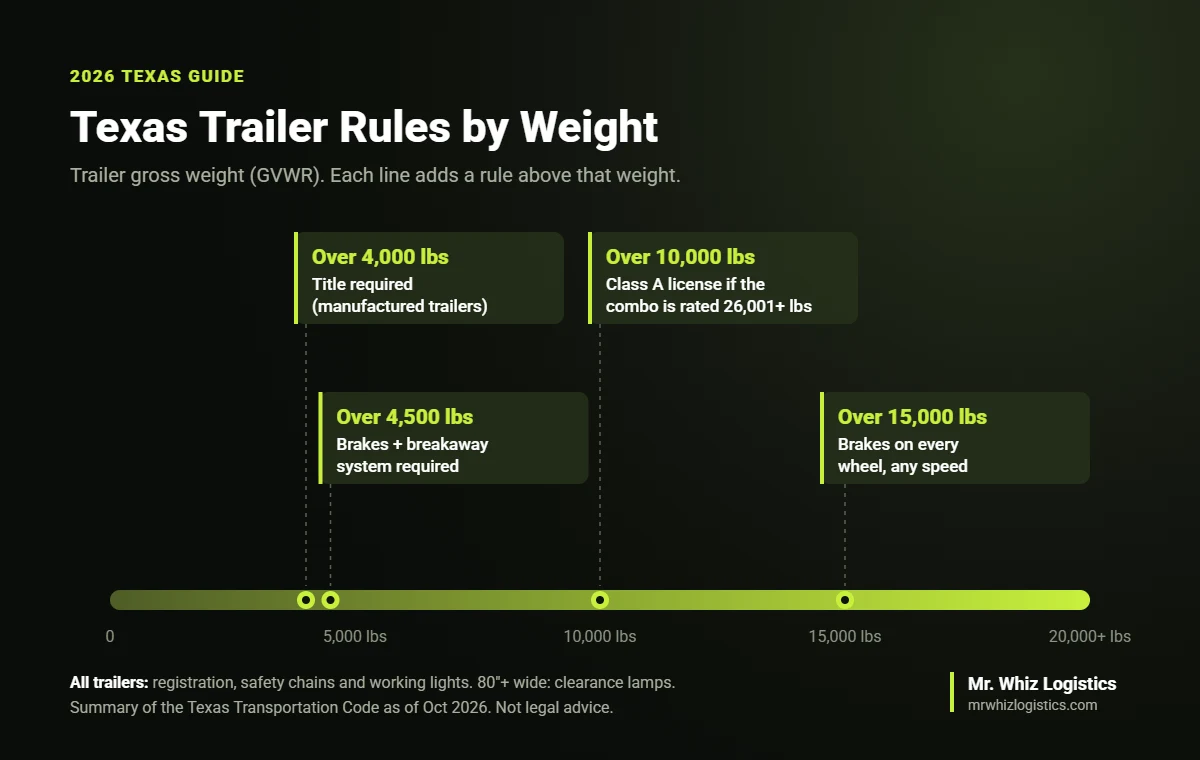
Brakes are the rule people ask about most, and the one that matters most on a loaded trailer. Under Transportation Code $547.401 and $547.402, the requirement depends on the trailer's gross weight:
Trailer gross weight | Brakes required? | Which wheels |
|---|---|---|
4,500 lbs or less | No | None required |
4,501 to 15,000 lbs | Yes, when towed faster than 30 mph | At least both wheels of the rear axle. Surge (inertia) brakes are allowed. |
Over 15,000 lbs | Yes, at any speed | Every wheel |
In practice, almost every road you'll use is above 30 mph, so treat any trailer over 4,500 lbs as needing brakes. That includes most dump trailers, car haulers and large enclosed trailers.
Breakaway brakes. Under $547.405, a trailer over 4,500 lbs must have brakes that apply automatically if it separates from the truck, and they must stay applied for at least 15 minutes. The tow vehicle's own brakes must also be able to stop it if the trailer breaks away. Before every trip, plug the breakaway cable into the truck, not into the safety chain.
Brake controller. Electric trailer brakes only work if the truck has a brake controller that the driver can adjust from the seat. If your truck doesn't have one, have one installed before you rent a heavy trailer.
For example, our 16 ft dump trailer is rated at 14,000 lbs and our 20 ft flatbed at 8,000 lbs. Both need working brakes, a breakaway system and a brake controller in your truck.
Safety Chains and Hitch Rules
Section 545.410 says the driver of a passenger car or light truck may not tow a trailer unless approved safety chains are attached in an approved way. Agricultural trailers are exempt. The law defines safety chains as the backup connection that keeps the trailer attached if the hitch fails.
To set them up the right way:
Cross the two chains under the trailer tongue so they can catch it if it drops.
Leave just enough slack to make tight turns, but don't let the chains drag on the road.
Use chains and hooks rated for at least the trailer's gross weight.
Match the ball to the coupler. Light utility trailers often use a 2" ball, while heavier bumper-pull trailers use 2-5/16". Gooseneck trailers need a gooseneck hitch in the truck bed.
Texas Trailer Light Laws
Every trailer needs working tail lights, brake lights, turn signals and red rear reflectors, plus a light on the rear license plate. Texas sets these out in Chapter 547 of the Transportation Code. Test them with a helper before you pull out, because a dead brake light is one of the easiest tickets to get.
Wide trailers need more lights. Under $547.352, a trailer that is 80 inches wide or more must have:
2 clearance lamps on the front and 2 on the rear, one on each side
4 side marker lamps, near the front and rear on each side
4 side reflectors, near the front and rear on each side
Hazard warning lamps
Many dump trailers and flatbeds are wider than 80 inches. Our 16 ft dump trailer is 83 inches wide, so these rules apply to it.
Loads that stick out. A load may extend no more than 3 feet past the front or 4 feet past the rear of the vehicle without a permit ($621.206). Any load that sticks out past the sides, or reaches 4 feet past the rear, must be marked: red flags at least 12 inches square in daylight, and red lamps and reflectors at night ($547.382).
Trailer Size Limits in Texas
Limit | Maximum | Law |
|---|---|---|
Width, including the load | 102 inches (8.5 ft) | |
Height, including the load | 14 feet | |
Truck and trailer combination | 65 feet | |
Load overhang | 3 ft front, 4 ft rear | §621.206 |
If a vehicle is taller than 13 feet 6 inches, the driver must make sure it clears every bridge and overpass on the route. Anything over these limits needs an oversize permit from the Texas Department of Motor Vehicles before it moves.
Weight is just as important. Never load a trailer past its GVWR, the maximum weight printed on its VIN plate. Also check that your truck's towing capacity and hitch rating are higher than the loaded trailer's weight.
Do You Need a CDL to Pull a Trailer in Texas?
For most people, no. A regular Class C license covers most pickups pulling most trailers. But Texas has license classes for heavy combinations that apply even when you're not towing for work. Here is how the Texas DPS license classes work:
License | What it covers |
|---|---|
Class C | Any vehicle or combination that isn't Class A or B. This covers most pickups pulling utility, enclosed and bumper-pull trailers. |
Class B | A single vehicle rated 26,001 lbs or more, towing a trailer rated 10,000 lbs or less |
Class A | A combination rated 26,001 lbs or more, when the trailer is rated over 10,000 lbs |
If you tow for personal use, Texas issues a non-commercial Class A or B license, so you don't need a CDL. DPS notes that drivers who are exempt from a CDL "may still be required to obtain a Class A or B driver license." If you tow for a business, a combination in the Class A range usually requires a commercial driver license (CDL).
How to check your numbers:
Find the trailer's GVWR on its VIN plate or in the rental listing.
Find your truck's gross combination weight rating (GCWR) in the owner's manual or the manufacturer's towing guide. If there isn't one, add the truck's GVWR and the trailer's GVWR.
If the trailer is over 10,000 lbs and the combination is 26,001 lbs or more, you need a Class A license.
Here's how that works with real rental trailers. A 40 ft gooseneck flatbed rated at 20,000 lbs is well over 10,000 lbs. Paired with almost any pickup, the combination tops 26,001 lbs, so it needs a Class A license. A 24 ft enclosed trailer rated at exactly 10,000 lbs is not over the line, so a Class C license works with a normal pickup.
The type of hitch doesn't change the answer. A gooseneck and a bumper-pull trailer follow the same weight rules.
Texas Trailer Registration and Title Rules
According to the Texas Department of Motor Vehicles, every non-farm trailer that uses public roads must be registered. Whether it also needs a title depends on weight:
Trailer type | Title | Registration |
|---|---|---|
Manufactured trailer, 4,000 lbs or less | Not required | Required |
Manufactured trailer, over 4,000 lbs | Required | Required |
Homemade trailer | Optional at 4,000 lbs or less | Required, after it gets a VIN |
Farm trailer, 4,000 lbs or less | Exempt | Exempt if used mainly for farming |
Farm trailer, 4,001–34,000 lbs | Exempt (optional) | Farm Trailer plate, $5 |
Any trailer over 34,000 lbs | Required | Regular trailer plates |
The base state registration fee for a trailer weighing 6,000 lbs or less is $45 a year ($502.254). Heavier trailers pay by weight, and counties add local fees.
A homemade trailer must be inspected by an auto theft officer to get a VIN before it can be registered. TxDMV's forms for this are VTR-141, VTR-68A and VTR-68-N.
If you're renting, the rental company handles registration. Just check that the plate is on the trailer and the registration is current before you leave the lot.
Do Trailers Need an Inspection in Texas?
Not anymore for most people. Under House Bill 3297, non-commercial vehicles no longer need a safety inspection before registration, starting January 1, 2025, according to Texas DPS. Instead, owners pay a $7.50 inspection program replacement fee when they register.
That change covers personal trailers that used to need an annual sticker. Commercial vehicles still need a yearly safety inspection in every county. Emissions testing doesn't apply to trailers, since they have no engine.
You'll still find older guides online that say trailers over 4,500 lbs need an annual inspection. For non-commercial use, that rule ended in 2025.
Speed Limits When Towing a Trailer in Texas
Texas doesn't set a separate speed limit for vehicles towing a trailer. The speed limit rules in $545.352 apply to trailers the same as cars: for example, 70 mph on numbered highways outside cities and 30 mph on city streets, unless signs say otherwise.
The law also requires a speed that is "reasonable and prudent" for conditions (§545.351). A loaded trailer takes much longer to stop, crosswinds on I-20 or I-35 can push it around, and many trailer tires are rated for lower speeds than car tires. Check the speed rating on the tire sidewall, and drive below the limit when you're heavy.
Towing for Work? Extra Rules to Know
If you tow for a business, such as delivering equipment, hauling materials for customers or running hot shot loads, more rules can apply:
CDL: Combinations in the Class A or B weight range used for business usually require a CDL.
USDOT number: The FMCSA requires one for interstate commercial vehicles rated 10,001 lbs or more, and Texas also requires USDOT numbers for some intrastate carriers.
Inspections: Commercial vehicles still need an annual safety inspection.
Covered loads: Under $725.021, loose material like dirt, gravel or debris must be covered or enclosed so it can't blow or spill, and the tailgate must be closed. Landfills enforce this too. Dallas's McCommas Bluff Landfill charges a $40 uncovered load fee.
Pre-Trip Checklist for Towing a Trailer in Texas
The trailer's GVWR is within your truck's towing capacity and hitch rating.
You have the right license for the combination (Class C, or Class A if it's over the line).
The ball size matches the coupler, and the coupler is latched and pinned.
The safety chains are crossed and hooked, with no dragging.
The breakaway cable is attached to the truck.
The brake controller works and is set for the load.
Tail lights, brake lights, turn signals and clearance lights all work.
The registration is current and the plate is visible.
Loose loads are tarped, and any overhang is flagged.
The tires are inflated to the pressure on the trailer's VIN plate.
Frequently Asked Questions
Do I need a CDL to pull a trailer in Texas?
Not for personal use. Most pickups pulling most trailers need only a Class C license. If the trailer is rated over 10,000 lbs and the combination is rated 26,001 lbs or more, you need a Class A license, which is non-commercial for personal use. Towing that combination for a business usually requires a CDL.
Do I need a CDL to pull a gooseneck trailer in Texas?
It depends on weight, not on the hitch. A gooseneck trailer rated over 10,000 lbs, in a combination rated 26,001 lbs or more, requires a Class A license. That license is non-commercial for personal use, and a CDL is usually needed for business use.
Does a utility trailer need brakes in Texas?
Only if its gross weight is over 4,500 lbs and it's towed faster than 30 mph. Most small utility trailers fall under 4,500 lbs and don't need brakes.
Do trailers need to be inspected in Texas?
Not for non-commercial use. Since January 1, 2025, non-commercial vehicles don't need a safety inspection to register. Owners pay a $7.50 replacement fee instead, and commercial vehicles still need yearly inspections.
Do I need to register a small trailer in Texas?
Yes. Every non-farm trailer on public roads must be registered. Trailers of 4,000 lbs or less don't need a title, but they still need registration and a plate.
What is the speed limit when pulling a trailer in Texas?
Texas has no separate trailer speed limit. You follow the posted limit, but you must drive at a speed that's reasonable for the load and conditions.
Which trailers need clearance lights in Texas?
Trailers 80 inches wide or more need front and rear clearance lamps, side marker lamps, side reflectors and hazard lamps.
Rent a Road-Ready Trailer in Dallas–Fort Worth
Mr. Whiz Logistics rents dump, flatbed, enclosed and utility trailers from Wylie, TX, on daily, weekly and monthly terms. Not sure your truck or license fits the trailer you need? Call +1 (214) 217-6302 before pickup and we'll help you pick the right one. Planning a cleanup? See what a dump trailer costs to rent in Dallas, or request a free quote.
This guide summarizes Texas law as of October 2026 for general information. It isn't legal advice. Check the linked statutes or contact Texas DPS or TxDMV for your situation.