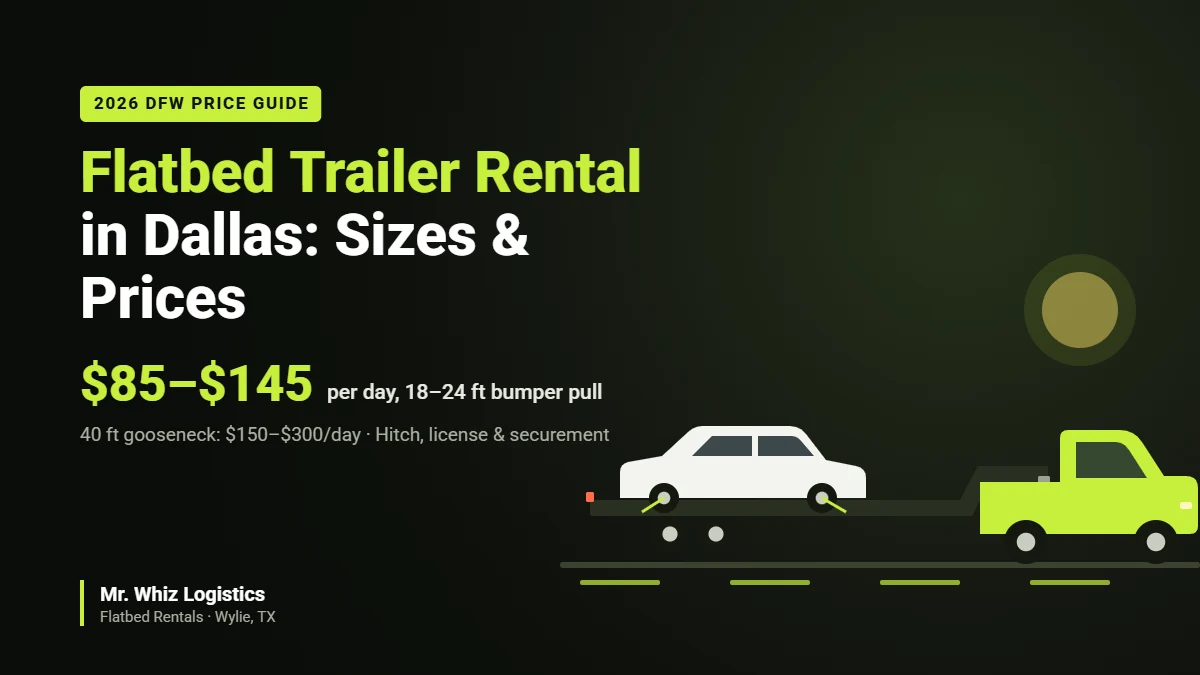
Maybe you need to move a skid steer from Garland to a job site in Frisco, pick up a project car in Arlington, or haul 30-foot steel pipe across the Metroplex. Whatever the load, a flatbed trailer is usually the answer, and the first question is what it costs. In 2026, most 18–24 ft bumper-pull flatbeds and car haulers in Dallas–Fort Worth rent for about $85 to $145 a day, and 35–40 ft gooseneck flatbeds run about $150 to $300 a day.
The right trailer depends on what you're hauling, how much it weighs and what your truck can pull. This guide compares DFW flatbed rental prices, trailer types and sizes, hitch and license rules, and how to strap a load down safely. If you'll tow it yourself, also read our Texas trailer laws guide.
Flatbed Trailer Rental Cost in Dallas–Fort Worth (2026)
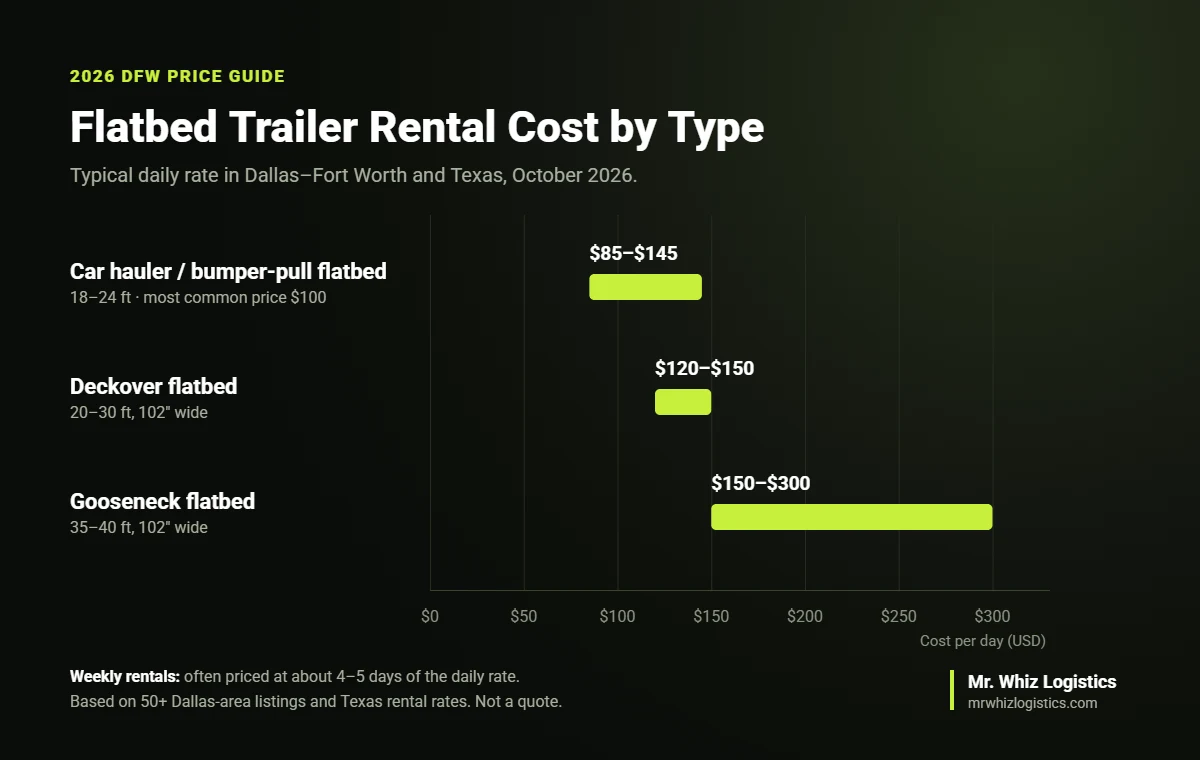
We looked at more than 50 Dallas-area flatbed, car hauler and gooseneck listings on trailer rental marketplaces, plus published rates from Texas rental companies, in October 2026. Here's what the market looks like:
Trailer type | Typical size | Typical daily rate | Hitch |
|---|---|---|---|
Car hauler or bumper-pull flatbed | 18–24 ft, about 7,000–10,000 lb rating | $85–$145 (most $100–$125) | Ball hitch, usually 2-5/16" |
Deckover flatbed | 20–30 ft, 102" wide | $120–$150 | Ball or pintle |
Gooseneck flatbed | 35–40 ft, 102" wide | $150–$300 | Gooseneck ball in the truck bed |
The most common daily price for a 20 ft car hauler or flatbed in the Dallas area was $100. Newer trailers, hydraulic tilt decks, air-ride goosenecks and drive-over fenders sit at the top of each range.
Multi-day rentals usually cost less per day. A weekly rental is often priced at about four to five days' worth, so ask for a weekly or monthly quote if the job will run longer than a few days.
At Mr. Whiz Logistics, our 20 ft flatbed and 40 ft gooseneck flatbed rent on daily, weekly and monthly terms, with one upfront price. Call (214) 217-6302 for a quote.
Types of Flatbed Trailers You Can Rent
Car hauler. A low 16–22 ft bumper-pull flatbed with ramps, often with a winch. It's the go-to choice for one car, a pickup, a UTV or a small tractor.
Bumper-pull flatbed. Similar to a car hauler but built for mixed loads like lumber, pallets, pipe and small equipment. Stake pockets and rub rails give you more places to tie down.
Deckover. The deck sits above the wheels, so it's a full 102 inches wide. It's good for wide pallets and equipment that won't fit between fenders.
Tilt deck. The deck tilts down to the ground, so there are no ramps to set. It's handy for low-clearance cars and rolling equipment.
Gooseneck flatbed. A 30–40 ft deck that hitches to a ball in the truck bed. It tows more steadily than a bumper-pull and carries the longest and heaviest loads: multiple vehicles, skid steers, steel and lumber packages.
For light loads like a riding mower, furniture or landscaping supplies, a 16 ft utility trailer costs less and is easier to tow.
20 ft Bumper-Pull vs. 40 ft Gooseneck Flatbed
Most DFW renters end up choosing between these two sizes. Here's how our two flatbeds compare:
Feature | 20 ft flatbed | 40 ft gooseneck flatbed |
|---|---|---|
Deck | 20 ft x 82 in | 40 ft x 102 in |
Weight rating (GVWR) | 8,000 lbs | 20,000 lbs |
Hitch | 2-5/16" ball (bumper pull) | Gooseneck ball or pintle hook |
Included | 12,000 lb winch, 4 axle straps, 4 ratchet tie-downs | 12,000 lb winch, 8 ratchet tie-downs, stake pockets |
Best for | One car or truck, a compact tractor, lumber and pallets | Skid steers, multiple vehicles, steel, pipe, trusses, long loads |
Tow vehicle | Full-size pickup with a brake controller | Heavy-duty pickup with a bed-mounted gooseneck ball and a brake controller |
Texas license | Class C for most pickups | Usually Class A (non-commercial for personal use) |
How Much Can a Flatbed Trailer Carry?
A trailer's weight rating (GVWR) includes the trailer itself. To find how much cargo it can carry, subtract the trailer's empty weight from its GVWR. For example, a 40 ft Big Tex gooseneck rated at 23,900 lbs weighs about 8,120 lbs empty, so it can carry about 15,780 lbs. Ask the rental company for the empty weight, or find it on the VIN plate.
Here's how common DFW loads match up:
Load | Approximate weight | Trailer that fits |
|---|---|---|
Average new car or SUV | About 4,350 lbs | 20 ft flatbed or car hauler |
Mini skid steer (such as a Bobcat S70) | About 2,900 lbs | 20 ft flatbed |
Full-size pickup or large SUV | Often over 5,000 lbs | Check the 20 ft trailer's payload first, or use the 40 ft |
Two cars, or a car plus equipment | 8,000–10,000 lbs | 40 ft gooseneck |
Steel, pipe or lumber longer than 20 ft | Varies | 40 ft gooseneck |
Equipment over 10,000 lbs | 10,000 lbs or more | 40 ft gooseneck, or hire a hot shot |
The average new vehicle weighed 4,354 lbs in model year 2024, according to the EPA Automotive Trends Report. The Bobcat S70 weighs 2,892 lbs, per Bobcat's specs. Always check the curb weight or operating weight of what you're hauling, and keep it centered slightly ahead of the trailer axles.
How to Secure a Load on a Flatbed Trailer
On a flatbed, the straps are the only thing holding your load. The federal cargo securement rules for commercial trucks in 49 CFR Part 393 are a good standard for anyone:
Strength: The working load limits of all your straps or chains added together should be at least half the weight of the cargo (§393.106).
Count by length: Use at least two tiedowns for an item up to 10 ft long, plus one more for every extra 10 ft (§393.110). One tiedown is enough only for items 5 ft or shorter and 1,100 lbs or less.
Heavy equipment: Machines of 10,000 lbs or more need at least four tiedowns, placed as close as practical to the front and rear (§393.130).
A few practical habits help too. Secure cars by their axles or wheels, not the body. Use chains and binders on steel-tracked equipment. Put edge protectors under straps on sharp corners. Stop and re-check every strap after the first few miles. Texas also requires loose material to be covered so it can't blow off, and any load that sticks out past the sides or rear to be flagged. Our Texas trailer laws guide covers the details.
Do You Need a Gooseneck Hitch or a CDL?
A gooseneck trailer needs a gooseneck ball mounted in the bed of a heavy-duty pickup, a trailer brake controller and a 7-pin plug. A bumper-pull flatbed only needs a receiver hitch with the right ball, usually 2-5/16" on trailers this size.
For licenses, Texas goes by weight ratings, not hitch type. You need a Class A license when the trailer is rated over 10,000 lbs and the truck-and-trailer combination is rated 26,001 lbs or more (Texas DPS). For personal use, that's a non-commercial Class A. Towing that combination for a business usually requires a CDL.
A 40 ft gooseneck rated at 20,000 lbs is over that line with almost any pickup. A 20 ft flatbed rated at 8,000 lbs is not, so a regular Class C license works.
You'll see some goosenecks advertised as "non-CDL." That usually means no commercial license is needed for personal use. It doesn't mean any license works. Ask for the trailer's GVWR and check your truck's ratings before you book.
What You Need to Rent a Flatbed Trailer in DFW
A truck rated to tow the trailer plus your load, with a working brake controller and the right wiring plug
The right hitch: a 2-5/16" ball for most bumper-pull flatbeds, or a gooseneck ball for goosenecks
The right license for the combination (Class C, or Class A for heavy goosenecks)
A valid driver's license, current insurance and a credit card for the deposit
At Mr. Whiz Logistics, renters must be 21 or older, and pickup is in Wylie, TX
Rent a Flatbed or Hire a Hot Shot?
Renting makes sense when you have the right truck, can load and strap the cargo yourself, and the trip is local. Hiring a 40 ft flatbed hot shot makes more sense when:
You don't have a heavy-duty truck with a gooseneck hitch, or a Class A license.
The load is heavy, oversized or hard to secure.
The delivery is long distance or time-critical.
You want the load insured and handled by a professional driver.
See what that costs in our guide to hot shot trucking costs in Texas.
6 Ways to Save on a Flatbed Trailer Rental
Rent the smallest trailer that fits. A 20 ft flatbed costs much less than a 40 ft gooseneck, and it's easier to tow.
Book weekly for longer jobs. Weekly rates are often about four to five days' worth.
Pick it up yourself to skip delivery fees.
Bring your own straps and chains if the rental doesn't include enough for your load.
Measure and weigh first. Knowing the length, width and weight up front avoids a second trip or the wrong trailer.
Ask for an all-in quote that includes tax, fees, the winch and tie-downs.
Frequently Asked Questions
How much does it cost to rent a flatbed trailer in Dallas?
Most 18–24 ft bumper-pull flatbeds and car haulers in Dallas–Fort Worth rent for about $85 to $145 a day in 2026, and $100 is the most common price for a 20 ft trailer. Deckovers run about $120 to $150 a day.
How much is a gooseneck trailer rental?
A 35–40 ft gooseneck flatbed in the Dallas area usually rents for about $150 to $300 a day. Newer, air-ride and heavier-rated trailers cost the most.
Does U-Haul rent flatbed trailers?
U-Haul rents car trailers and a 16 ft flatbed toy hauler, but not gooseneck trailers or large 30–40 ft flatbeds. For those, you'll need a trailer rental company.
Can I haul a car on a flatbed trailer?
Yes. A 20 ft flatbed or car hauler with a winch and axle straps fits most cars and small trucks. The average new vehicle weighs about 4,350 lbs, so check that the car plus the trailer stays under the trailer's GVWR.
Do I need a CDL to pull a 40 ft gooseneck in Texas?
Not for personal use, but you usually need a non-commercial Class A license, because the trailer is rated over 10,000 lbs and the combination is usually rated 26,001 lbs or more. Hauling for a business usually requires a CDL.
What truck do I need to pull a flatbed trailer?
A 20 ft flatbed rated at 8,000 lbs usually needs a full-size pickup with a 2-5/16" ball and a brake controller. A 40 ft gooseneck rated at 20,000 lbs needs a heavy-duty 3/4-ton or 1-ton pickup with a bed-mounted gooseneck ball. Always check your truck's towing capacity.
How many straps do I need to secure a load on a flatbed?
Use at least two tiedowns for anything up to 10 ft long, plus one for each extra 10 ft, and make sure their combined working load limit is at least half the cargo's weight. Equipment of 10,000 lbs or more needs at least four.
Rent a 20 ft or 40 ft Flatbed in Wylie and DFW
Mr. Whiz Logistics rents a 20 ft flatbed with a 12,000 lb winch and axle straps, and a 40 ft gooseneck flatbed with eight ratchet tie-downs and stake pockets. Both rent from Wylie, TX, on daily, weekly and monthly terms, serving Garland, Rowlett, Sachse, Murphy, Plano and the rest of Dallas–Fort Worth. See all trailer rentals, call +1 (214) 217-6302, or request a free quote.