Refrigerated freight leaves no room for mistakes. If a load of produce, meat or ice cream warms up on the road, the receiver can turn it away at the dock. Reefer trucking keeps those loads at the right temperature from pickup to delivery.
Shipping a cold load out of Dallas? Call (214) 217-6302 or get a free quote. Our dispatch in Garland runs 24/7 and books refrigerated and frozen full truckloads nationwide.
This guide covers what reefer trucking costs in 2026, how temperature settings work, what to send for a quote, and how to protect your load in the Texas heat.
What Is Reefer Trucking?
A reefer is a refrigerated trailer, usually 53 ft long, with insulated walls and a diesel refrigeration unit mounted on the front. The unit holds the temperature the shipper sets, from below freezing to cool, for the whole trip. Reefer loads are usually full truckloads moved by a semi truck.
Dallas–Fort Worth is a busy reefer market. Food distribution centers, grocery warehouses and cold storage sites across the metro ship and receive refrigerated freight every day, and Texas is one of DAT's ten "bellwether" reefer states that move most of the country's reefer freight (DAT).
Reefer Trucking Rates in 2026
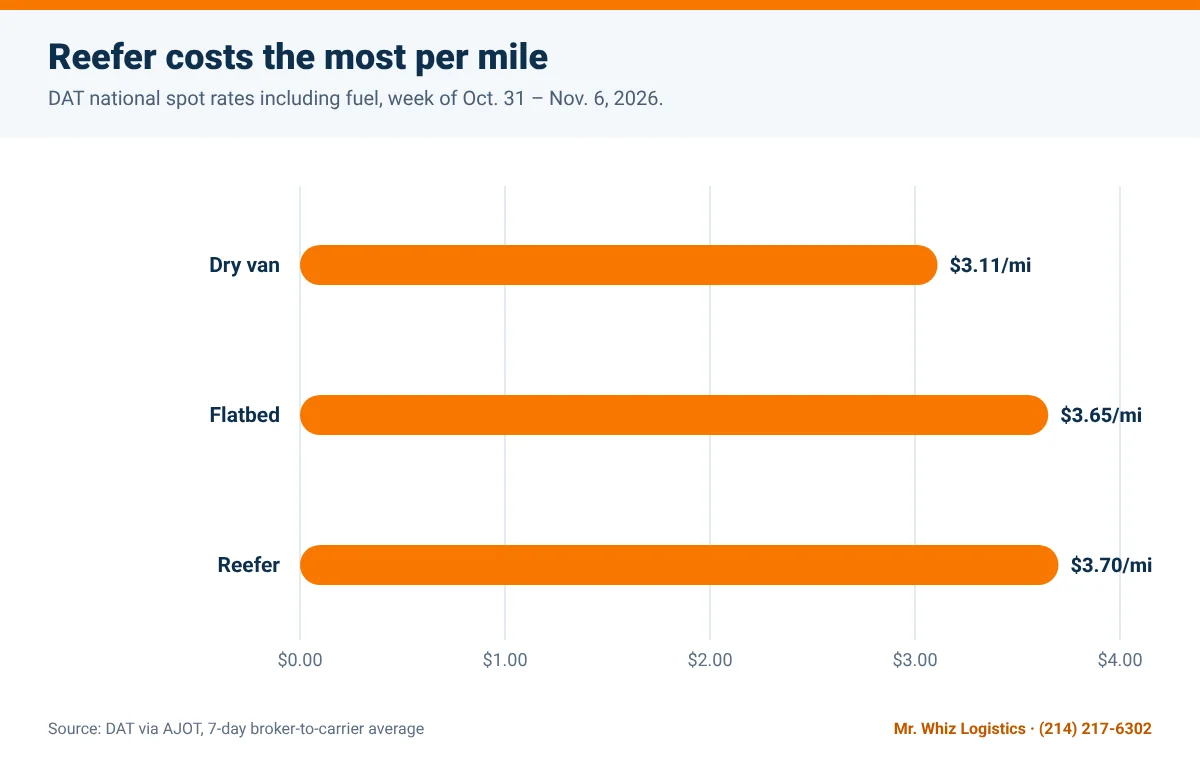
Reefer is the most expensive of the three main trailer types on the spot market. Here are DAT's national spot rates for the week of Oct. 31 to Nov. 6, 2026 (AJOT, DAT data):
Equipment | All-in spot rate (with fuel) | Linehaul only |
|---|---|---|
Reefer | $3.70 per mile | $2.77 per mile |
Flatbed | $3.65 per mile | $2.63 per mile |
Dry van | $3.11 per mile | $2.26 per mile |
Rates have climbed fast this year. DAT reported the national reefer linehaul rate at $2.78 per mile for the week ending Nov. 13, 2026, up 34% from a year earlier, with the reefer load-to-truck ratio at 17.65 (DAT). Fewer trucks for each load means higher prices, especially before Thanksgiving and other holidays.
These are national averages, not a quote. Short trips around Dallas often cost more per mile, because the truck still has to be pre-cooled, loaded and unloaded no matter how far it goes. For a sense of total cost, a 500-mile load at the national all-in rate of $3.70 per mile works out to about $1,850.
Why Reefer Costs More Than a Dry Van
The equipment. A reefer trailer and its refrigeration unit cost more to buy and maintain than a dry van.
Fuel for the unit. The refrigeration unit burns its own diesel the whole time it runs, including while the truck waits at the dock.
Fewer trucks. There are far fewer reefers than dry vans, so capacity gets tight when produce and holiday freight peak.
Tighter appointments. Cold storage and grocery docks run on strict schedules, and late or rejected loads are costly.
If your freight does not need temperature control, a 53 ft dry van is usually the cheaper choice.
Temperature Settings and Unit Modes
The shipper sets the temperature, not the carrier. Under the FDA's sanitary transportation rule, vehicles must be able to hold the temperatures needed to move food safely, and shippers tell carriers in writing what those requirements are (FDA).
Load type | What it usually means | Typical unit mode |
|---|---|---|
Frozen | Ice cream, frozen meat, frozen meals. The shipper sets a below-freezing setpoint. | Often cycle, if the shipper allows |
Chilled / fresh | Meat, dairy, eggs, many fruits and vegetables. Cold but not frozen. | Usually continuous |
Cool or protected | Chocolate, candles, cosmetics, some chemicals and adhesives in Texas heat. | Continuous or cycle, per shipper |
Two rules from the road: the trailer should be pre-cooled to the setpoint before loading, and your product should already be at that temperature. A reefer is built to hold temperature, not to cool down warm freight.
What to Send for a Reefer Quote
Item | Why it matters |
|---|---|
Pickup and delivery address | Sets the miles and the lane rate |
Product, weight and pallet count | Confirms it fits the trailer and stays under the legal weight |
Temperature setpoint | Written on the bill of lading so the driver sets the unit correctly |
Continuous or cycle | Changes fuel use and how steady the air temperature stays |
Pickup and delivery appointments | Cold storage docks often run on tight appointment windows |
Special needs | Temperature records, seals, multi-stop, team drivers |
A 53 ft reefer usually fits up to 26 standard pallets loaded single-stacked. The refrigeration unit and insulation add weight, so the legal payload is usually a little lower than a dry van's. Tell us your real weight up front.
Protecting Reefer Loads in Texas Heat
Pre-cool the product, not just the trailer. Warm pallets loaded into a cold trailer are the most common cause of temperature problems.
Load for airflow. Leave space at the top and back of the load so cold air can move around the pallets.
Keep dock time short. Every minute with the doors open on a 100°F day lets heat in.
Write it down. Put the setpoint and mode on the bill of lading, and ask for temperature records if your customer needs them.
Use a reefer for heat-sensitive goods too. Chocolate, candles and cosmetics can melt in a hot Texas trailer in July and August.
Reefer Trucking With Mr. Whiz Logistics
Mr. Whiz Logistics moves refrigerated and frozen full truckloads from Dallas–Fort Worth to destinations nationwide, with 24/7 dispatch from Garland, TX.
Reefer trailers for produce, meat, dairy, frozen food, beverages and flowers
Trailer pre-cooled to your setpoint before loading, monitored by the driver for the whole trip
Continuous or cycle mode, set the way your shipper requires
Live tracking and proof of delivery on every load
Dry van and flatbed semi service when your freight doesn't need cooling
Planning other freight? See our guides to Dallas to Houston freight shipping, expedited freight in Dallas and pallet shipping costs.
Ready to book a cold load? Call (214) 217-6302 or get a free quote with your lane, pallets and setpoint. We'll send an upfront price.
Frequently Asked Questions
What is reefer trucking?
Reefer trucking is freight shipped in a refrigerated trailer. The trailer has insulated walls and a refrigeration unit on the front that holds a set temperature, from frozen to cool, for the whole trip.
How much does reefer trucking cost per mile in 2026?
For the week of Oct. 31 to Nov. 6, 2026, DAT's national spot reefer rate was $3.70 per mile including fuel, or $2.77 per mile for linehaul only. Your price depends on lane, distance, weight, temperature and timing, so ask for a quote on your exact load.
Why does a reefer cost more than a dry van?
A reefer trailer costs more to buy and run, the refrigeration unit burns fuel the whole trip, and there are fewer reefer trucks than dry vans. In early November 2026, the national all-in spot rate was $3.70 per mile for reefer and $3.11 for dry van.
How many pallets fit in a 53 ft reefer trailer?
A 53 ft reefer usually fits up to 26 standard 48 x 40 inch pallets loaded single-stacked. Its legal payload is usually a little lower than a dry van's, because the refrigeration unit and insulation add weight.
Does the reefer cool my product down during the trip?
No. A reefer is built to hold temperature, not to pull warm product down. Your product should already be at the right temperature when it is loaded, and the trailer should be pre-cooled to the setpoint.
Should the reefer unit run continuous or cycle?
Continuous mode keeps air moving the whole time and is the usual choice for fresh produce and other sensitive loads. Cycle mode turns the unit on and off to save fuel and is common for frozen product. Put the mode on the bill of lading.
Does Mr. Whiz Logistics haul refrigerated freight from Dallas?
Yes. Mr. Whiz Logistics moves refrigerated and frozen full truckloads from Dallas–Fort Worth to destinations nationwide, dispatched 24/7 from Garland, TX. Call (214) 217-6302 for a free quote.